
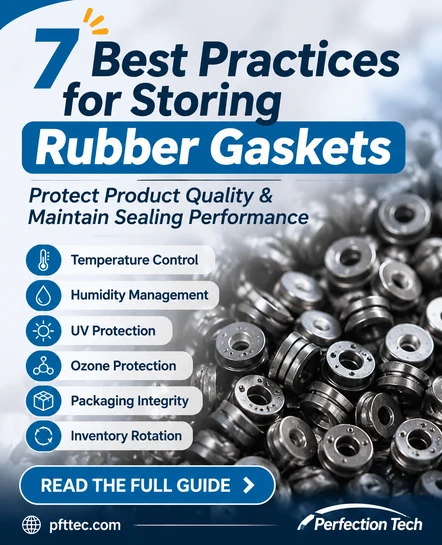
Rubber gaskets are widely used in medical, pharmaceutical, laboratory, and industrial applications where reliable sealing performance is critical. They help prevent leakage, support sealing system integrity, and protect products from contamination in applications where reliable sealing is essential.
While considerable attention is often given to manufacturing quality, storage conditions are equally important in maintaining long-term product performance. Even high-quality rubber gaskets may experience changes in their physical properties if stored improperly. Temperature fluctuations, moisture, sunlight exposure, and chemical contamination can all contribute to material degradation over time.
Understanding and implementing proper storage practices can help maintain gasket integrity, preserve product quality throughout its specified shelf life, and support consistent performance when the product is eventually put into service.
1. Store Rubber Gaskets at a Stable Temperature
Temperature is one of the most significant factors affecting rubber materials.
Excessive heat can accelerate aging, causing rubber to harden, lose elasticity, or develop surface cracks. Extremely low temperatures may temporarily reduce flexibility and, in some cases, contribute to brittleness when the material is subjected to stress.
Storage temperature should be controlled according to the specific rubber material and the manufacturer's recommendations.
In general, rubber gaskets should be stored in a cool environment with minimal temperature fluctuations. Avoid excessive heat and direct contact with heat-generating equipment, as elevated temperatures can accelerate material aging and reduce storage life.
Maintaining a stable temperature is often more beneficial than allowing frequent fluctuations between warm and cold conditions.
2. Control Humidity Levels
Humidity can also influence the condition of stored products.
Excessive moisture and condensation may affect packaging integrity and increase the risk of contamination. Products should be stored in a clean and dry environment to minimize exposure to moisture.
To maintain appropriate storage conditions:
-
Avoid areas prone to condensation or water accumulation.
-
Keep products away from leaking roofs, pipes, and other water sources.
-
Store products in their original protective packaging whenever possible.
-
Monitor environmental conditions according to the manufacturer's recommendations.
Storage humidity should be managed according to the specific rubber material and packaging requirements.
3. Protect Against Direct Sunlight and UV Radiation
Many rubber materials are sensitive to ultraviolet (UV) light.
Prolonged exposure to direct sunlight can contribute to oxidation and gradual degradation of rubber surfaces. Common effects may include discoloration, hardening, reduced elasticity, and surface cracking.
To minimize UV exposure:
-
Keep products in their original cartons or opaque packaging.
-
Avoid placing inventory near windows or skylights.
-
Store products in shaded indoor environments whenever possible.
-
Minimize exposure to strong UV radiation.
Proper protection from direct sunlight and strong UV exposure can help minimize material degradation during storage.
4. Minimize Exposure to Ozone
Ozone is an often-overlooked factor that can negatively affect certain rubber materials.
Even at relatively low concentrations, ozone can react with susceptible types of rubber and cause small cracks to develop on the surface. Over time, these cracks may expand and compromise the gasket's sealing capability.
Potential sources of ozone or ozone-generating conditions may include:
-
Certain electric motors and electrical equipment
-
High-voltage electrical equipment
-
Welding equipment
-
Electrical switchgear
-
Ozone-generating lamps and devices
Whenever possible, rubber gaskets should be stored away from equipment and environments that generate ozone.
5. Keep Products in Original Packaging Until Use
Packaging serves an important protective function beyond transportation.
Original packaging helps shield products from dust, moisture, light, and accidental contamination. Opening packages unnecessarily can expose products to environmental conditions that may affect their quality during storage.
Best practices include:
-
Keeping packaging sealed until needed.
-
Limiting repeated opening and resealing.
-
Handling products with clean gloves when appropriate.
-
Returning partially used inventory to protective packaging promptly.
For sterile medical components, the integrity of the validated sterile barrier system must be maintained in accordance with the manufacturer's instructions.
Maintaining packaging integrity is particularly important for products intended for medical and pharmaceutical applications.
6. Avoid Excessive Compression and Mechanical Stress
Improper stacking or storage arrangements may deform rubber gaskets over time.
Placing heavy objects on top of cartons can compress products and potentially alter their shape. Depending on the material and storage duration, long-term deformation may affect sealing performance when the gasket is installed.
To prevent mechanical damage:
-
Store cartons on level, stable surfaces.
-
Avoid excessive stacking height.
-
Follow manufacturer recommendations for palletization and storage.
-
Protect products from crushing, bending, or impact.
Proper handling procedures can help ensure that products remain in their intended condition throughout storage.
7. Practice Effective Inventory Rotation
Even under appropriate storage conditions, rubber materials naturally age over time.
An organized inventory management system helps ensure that products are used within their recommended shelf-life period and reduces the risk of long-term storage-related issues.
Common inventory practices include:
-
Applying First-In, First-Out (FIFO) or First-Expired, First-Out (FEFO) inventory management principles, as appropriate.
-
Recording lot numbers and receipt dates.
-
Conducting periodic stock inspections.
-
Monitoring product expiration dates or recommended usage periods.
Regular inventory reviews can help identify products that require further evaluation before use and support overall quality management efforts.
Signs That Gaskets Should Be Inspected Before Use
Before products are released for production or installation, a visual inspection can help identify potential storage-related issues.
Common warning signs include:
-
Discoloration
-
Surface cracks
-
Hardening or brittleness
-
Loss of elasticity
-
Sticky surfaces
-
Visible contamination
-
Packaging damage
If any abnormalities are observed, the affected products should be placed on hold pending further inspection and appropriate quality evaluation before use.
Conclusion
Proper storage is essential for maintaining the performance, reliability, and service life of rubber gaskets. Environmental factors such as temperature, moisture, sunlight, ozone, and mechanical stress can all influence the long-term stability of rubber materials.
By following appropriate storage practices, organizations can reduce the risk of material degradation, help preserve sealing performance, and ensure that rubber gaskets remain suitable for their intended applications throughout their specified storage life.
Ultimately, effective storage management is not only a matter of protecting inventory but also an important component of overall product quality and operational reliability.
Disclaimer: This article is intended for general informational purposes only. Storage requirements may vary depending on the rubber material, product design, and intended application. Always follow the manufacturer's specifications, storage instructions, and applicable quality requirements.